School Time Table: Design Essentials for Creative Professionals
For graphic designers, marketers, and brand creators, a well-structured School Time Table is more than a scheduling tool—it's a powerful visual communication asset that enhances clarity, organization, and brand consistency. Whether used in educational institutions, corporate training programs, or digital learning platforms, a thoughtfully designed timetable communicates professionalism and improves user experience through smart typography, color harmony, and intuitive layout.
Why Visual Design Matters for School Time Tables
In today’s visually-driven world, the aesthetics and usability of a School Time Table directly influence how information is perceived and retained. A clean, well-structured layout with proper spacing, legible fonts, and logical hierarchy ensures that users can quickly locate information without confusion. This principle aligns closely with modern UI/UX design practices, where user-centric layouts enhance readability and engagement.
From a branding perspective, integrating brand colors, fonts, and design elements into a timetable reinforces brand identity across all communication touchpoints. This consistency builds trust and familiarity, especially when timetables are distributed across print, digital, and social media platforms.
Applications Across Creative Projects
The versatility of a professionally designed School Time Table extends beyond education. Here are some key creative applications where it adds value:
- Branding and Logo Design: Incorporating brand elements into timetable templates strengthens brand presence.
- Marketing Materials: Used in school brochures, orientation kits, or event schedules.
- Social Media Graphics: Visual timetables adapted for Instagram or Facebook posts enhance engagement.
- Web Design: Responsive timetable layouts improve website usability for online learning platforms.
- Editorial Design: Integrated into educational magazines or course handbooks.
Design Considerations for Optimal Results
Creating a high-quality School Time Table requires attention to several key design principles:
- Typography: Choose fonts that are easy to read at a glance. Sans-serif fonts like Arial or Helvetica work well for digital use, while serif fonts like Georgia can lend a traditional feel to print versions.
- Color Palette: Use a limited, cohesive color scheme that aligns with brand guidelines and enhances readability without overwhelming the viewer.
- Visual Hierarchy: Highlight key information such as time slots, subjects, and instructors using size, weight, and spacing.
- Consistency: Maintain uniformity in layout, alignment, and formatting across all timetable versions.
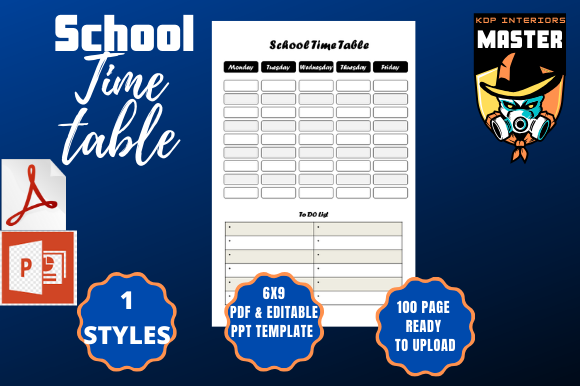
When designing for print, especially for platforms like KDP (Kindle Direct Publishing), ensure bleed settings are correctly configured to avoid unwanted white borders. The standard 6x9 inch format with 100 pages allows for flexibility in combining timetables with additional educational content, making it ideal for academic planners, course guides, and institutional handbooks.
Instant Download & Format Compatibility
Offering a School Time Table as an instant download in PDF and PPT formats ensures accessibility across both print and digital workflows. PDF files maintain formatting integrity across devices, while PPT versions allow for easy customization and presentation use. This dual-format approach caters to a wide audience—from educators who prefer print to digital marketers who repurpose content for slideshows or webinars.
For designers, ensuring compatibility with Adobe Illustrator or InDesign is crucial for seamless editing. Vector-based files allow for scalability without quality loss, which is essential for branding applications such as packaging design, merchandise, or advertising campaigns.
Ultimately, a well-crafted School Time Table is more than a schedule—it’s a reflection of thoughtful design and strategic communication. Whether used in editorial design, digital marketing, or UI/UX development, investing in high-quality, brand-aligned visual assets enhances clarity, builds trust, and elevates the overall user experience. By prioritizing usability, consistency, and aesthetic appeal, designers can create resources that serve both functional and creative purposes across a wide range of professional settings.